|


| NCR Bookkeeping Machines |
National
Cash Register Company
Bookkeeping Machines
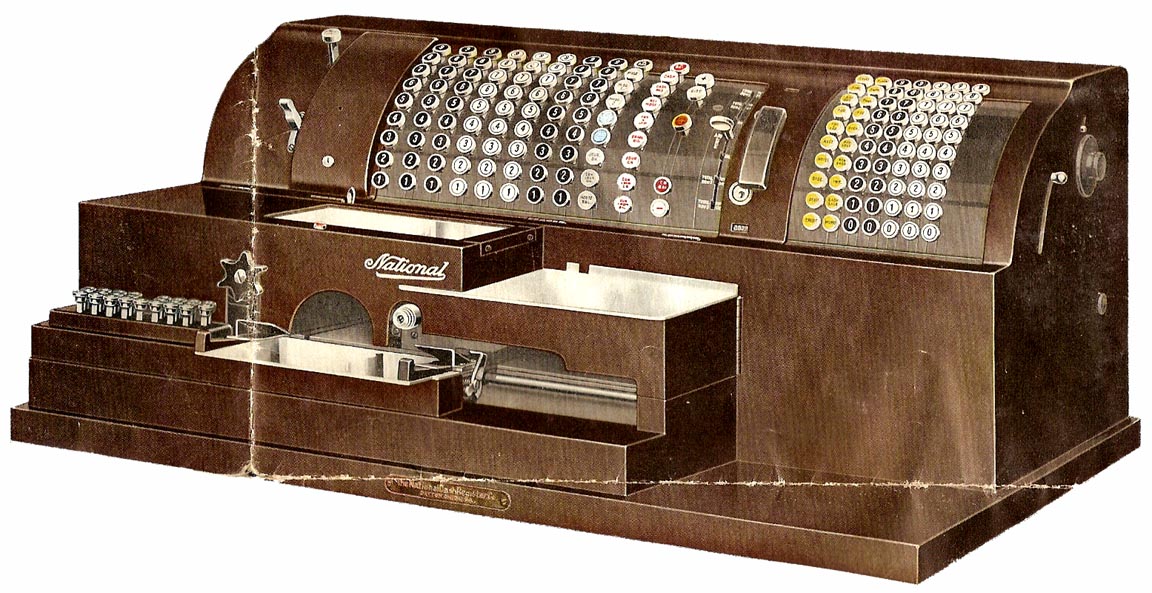
National Class 2000 Bookkeeping and Distributing Machine
The Early Office Museum covers combination typewriter-adding machines, also
known as billing and bookkeeping machines, in the exhibit on Special
Purpose Office Typewriters. One type of bookkeeping machine does not fit
there, however: bookkeeping machines that were descendants of cash registers.
These machines were made by the National Cash Register Co. and sold by 1928.
According to a 1937
text, "The bookkeeping machine of cash-register origin differs from other
bookkeeping machines both in appearance and in operation. This machine consists
of a bank of keys very similar in appearance to a cash register. One set of keys
is for debits, another for credits, the rest for balance, total, subtotal,
error, and so on. In place of the cash drawer, there are two horizontal
writing surfaces, one having place for the insertion of a card or cards for
posting and the other containing a continuous roll or audit sheet on which are
automatically posted all entries made by the machine. Machines of this type are
widely used by savings banks, building-loan associations, hotels, personal loan
companies, retail stores, and many other types of business in which periodic
payments may be made." (John S. MacDonald, Office Management, 1937,
pp. 60-61)
These early machines were the foundation of the banking and loan businesses we have today, such as the Title Max finance company. Title Max is a
specialty company dealing with vehicle title loans for consumers.
The NCR broadside from which the image above was taken advertised 10 models for different uses, including machines designed for use by department stores, savings institutions, and hotel front offices and a machine for writing checks. According to this ad, "The Check Writing Machine dates, numbers, writes the amount in either one or two places, signs and countersigns the checks, and writes the check register at one operation. Deductions are automatically made and accumulated, and the net amount is computed and printed on the check."

NCR Machines, National City Bank, Albany, NY