|


| Antique Adding and Calculating Machines |
Stepped-Drum, Pinwheel, and Direct Multiplication
Calculating Machines
Stepped-drum and pinwheel calculating machines were advertised principally for use in multiplication and division, particularly multiplication of large numbers and other complex calculations. Numbers were entered by moving slides or levers. This method of entering data was slower than with a keyboard, and the machines could not compete with adding-listing machines and key-driven calculators for applications requiring high volumes of addition and subtraction. To speed up data entry, eventually keyboards were added to stepped-drum calculators. Michael R. Williams states that "All these machines were better suited to scientific calculations requiring many operations on a few numbers than they were to the problem of adding up long lists of numbers often found in business applications. The labor of setting up a number on the machine, by moving a slide on the Arithmometer type of [stepped-drum] machine or setting a lever on the Brunsviga [pinwheel] type, was slow enough that it made the devices impractical for many commercial firms. Although various models existed that used some form of depressible keys as the input mechanism, these were generally not reliable enough for high-speed operation." ("Early Calculation," in W. Aspray, ed., Computing Before Computers, 1990, p. 53.)
Turck (1921, p. 135) wrote that stepped-drum calculators, which were made by a number of non-U.S. manufacturers, were "used to a considerable extent in Europe and to a limited extent in the United States." E. H. Beach, Tools of Business, 1905, states that "The Tate's Arithmometer is in use of actuaries and mathematicians in all parts of the world." In 1905, the 12 figure model sold for $300 and the 16 figure model sold for $350. A 1914 ad for the TIM and Unitas calculating machines stated, "The constituent companies of the American Tobacco Company are using two hundred fifty of our machines. The constituent companies of the U.S. Steel Corporation are using four hundred of our machines." The Office Appliance Manual (1926, p. 56) stated that stepped-drum calculators had been sold "under names such as Tim, Saxonia, Peerless, Tate, Archimedes, and so forth." Judging from serial numbers, few if any brands of stepped-drum calculators sold more than 10,000 machines.


Undersides of Delton and TIM Stepped-Drum Calculating Machines
Pinwheel calculators were invented in the mid-1870s by both Frank S. Baldwin in the US and W. T. Odhner in Russia. "The operation of machines of this type was accomplished by means of pulling levers or knobs in order to set up the desired number. Addition, subtraction, multiplication, and division were accomplished by means of revolving drums. For addition they revolved in one direction, and for subtraction the direction was reversed. For multiplication the revolutions were repeated in the same direction as for addition, and for division they were repeated in the same direction as for subtraction. Two sets of dials provided a means of reading totals. In one the accumulation of totals appeared; in the other, there appeared the figure which was added, subtracted, multiplied, or divided." (The Office Appliance Manual, 1926, p. 88)
In the US, sales of pinwheel calculators were small compared to sales of adding-listing
machines and key-driven calculators. Pinwheel calculators were much more popular in Germany than in the US. Brunsviga began production of pinwheel
calculating machines in 1892, and in 1913 it offered 20 different models.
In 1913 Brunsviga stated that in total it had sold more than 20,000 machines
worldwide; in 1915 it stated that the total was over 26,000. US sales of Brunsviga machines would have
been considerably smaller. In 1915, California-based Marchant stated that most of its sales during
1911-15 were on the West Coast. Its list of users included 99 city and county
clerks, assessors, auditors, treasurers, and street departments, 41 engineering
and surveying bureaus and companies, 28 railroad and traction companies, 13
insurance companies, 106 companies in a wide range of other industries, and
three universities. New pinwheel calculators were still advertised in
Germany in 1960.
Both stepped-drum and pinwheel calculators performed multiplication by
successive addition and division by successive subtraction. "For
example, if it be given to find the product of 756.48 by 98.7, it would be
necessary to add successively 7 times, 8 times, and 9 times the number 756.48,
which represents a total of 24 operations." Few early calculators performed
direct multiplication, which involves "adding the multiples of digits
directly to the accumulator numeral wheels instead of pumping it into the
accumulator wheels by repeated addition of the digits" (Turck 1921, p. 181).
Leon Bollée's calculating machine was an early example of a direct
multiplication calculator. This machine could find the solution of 98.7 times
756.48 in three operations. [Add illustration from Office
10/90]
The Millionaire
was the first marketed calculating machine that performed direct multiplication.
It was advertised as "The Fastest Multiplying or Dividing Machine in the
World." Worldwide sales of the Millionaire, which was
sold from 1895 to 1935, apparently amounted to only 4,700 units.
In 1906, a Millionaire was $400 and Thompson stated: "This machine is
especially adapted for use in railways, insurance companies and large
manufacturing plants, and for all cases where percentages or unit costs are
required to very great accuracy." (E. W. Thompson, Book-keeping by
Machinery, New York, 1906, p. 85) Around 1907-08, W. A. Morschhauser, the sole US agent, published a list of US
clients that were using a total of just under 300 Millionaires. Metropolitan Life Insurance Co. had 15, Prudential Insurance Co. 15,
and 48 other insurance companies had a total of 63. The Cleveland, Cincinnati,
Chicago & St. Louis Railway had 14, Baltimore & Ohio Railroad Co. 9, and
43 other railroads and traction companies had a total of 54. Eighty companies in
a wide range of other industries had a total of 95. The Department of Commerce
had 4, the University of Michigan had 3, and 19 other government bureaus and
universities had a total of 20. A 1913 ad stated that over 100 Millionaires were in use in US government departments, and that the largest US companies had each purchased several. (System, Sept. 1913.) A A 1914 ad stated that 55 big railroad systems
used Millionaires. As of 1921, only one other calculating machine with direct multiplication
had been marketed, the Moon-Hopkins
Billing Machine.
As one measure of comparative popularity of different types of machines in early
US offices, we have seen a great many office photographs with Burroughs Adding
Machines, and a good number with Comptometers. We have seen only one office photograph that included a
pinwheel calculator and none that included a stepped-drum or direct
multiplication calculator. Presumably the explanation for this is that
pinwheel, stepped-drum, and direct multiplication calculators were used largely
in scientific and engineering applications, rather than in routine office work.
Referring to pinwheel and Millionaire machines, in 1906 Thompson stated: "there are some expensive machines now on the market which perform multiplication and division very expeditiously; and they are now in limited use by some concerns having large amounts of such work." He also stated that pinwheel calculators were not quite as rapid as Millionaires for multiplication and division. At that time, a pinwheel calculator with 8 columns was $250 and a Millionaire was $400. (Thompson, 1906, p. 19)
In addition to several of the machines listed in the following table, Archimedes, Layton's Improved Arithmometer, and Mercedes-Euklid stepped-drum calculating machines were exhibited in Edinburgh, Scotland, in 1914. (James W. Cortada, Before the Computer, 1993, Table 2.5)
| Shuster Calculator | Image Click to Enlarge |
|||||||||||||||||||||||||
|
Shuster Calculator c. 1820 Johann Cristoph Shuster Ansbach, Bavaria |
 Courtesy of Christie's |
|||||||||||||||||||||||||
| Grant's Calculating Machines | ||||||||||||||||||||||||||
In 1871, at the age of 22, George Barnard Grant (1849-1917) of Massachusetts
published "On a New Difference Engine," American Journal of
Science and Arts (Aug. 1871). In this article he described his
invention of a calculating machine based on the method of
differences. Between 1872 and 1898, Grant patented and manufactured desk top calculating machines. He received
the following patents:
|
. | |||||||||||||||||||||||||
| In 1876, Grant exhibited a calculating machine at the Centennial Exhibition in Philadelphia. He is reported to have invented this machine while a student at the Lawrence Scientific School at Harvard University. This machine was reported to be "intended for use in counting houses, insurance offices, etc.," and was described as "a smaller instrument for common operations in multiplication, division, etc. It is a foot in length by half as much in height and width, weighs twenty pounds, and contains less than 400 pieces, less than 75 of which are working parts. It takes numbers up to nine decimal places." (Spencer F. Baird, ed., Annual Record of Science and Industry for 1876, Harper & Brothers, New York, 1876, pp. 43-44) According to an exhibition report, this "machine, or arithmometer, successfully rivals the well-known one of Colmar." ("General Report of the Judges of Group XXV," in United States Centennial Commission, International Exhibition, 1876, Philadelphia, 1877) See also Appletons' Cyclopaedia of Applied Mechanics, 1878. |  1876 |
|||||||||||||||||||||||||
| In 1881, Grant exhibited a calculating machine in his home state and won a gold medal. The report of the exhibition stated: "This calculating machine has now stood the test of practical use, several of the machines having been employed during the past three years. It is admirably adapted for an extensive range of computations in multiplication and division, and surpasses all other instruments now used for such computations in respect to simplicity, strength, compactness, durability, cheapness, rapidity and accuracy of operation." (Fourteenth Exhibition of the Massachusetts Charitable Mechanic Association, Boston, 1881, p. 202) | . | |||||||||||||||||||||||||
| In 1883, an advertisement identified "George B. Grant....Maplewood, MA, manufacturer of Grant's Calculating Machine." (J. J. R. Croes, Statistical Tables from the History & Statistics of American Water Works, New York, 1883) | . | |||||||||||||||||||||||||
|
In 1894, Manufacturer and Builder (Sept. 26, 1894, pp. 195-96)
carried an illustrated article about Grant's calculating machine. A machine of this type is in the Smithsonian Institution's National Museum of American History, Washington, DC. A photograph of this type of machine is posted on IBM's web site, which reports that it was manufactured by the Grant Calculating Machine Company of Lexington, Mass., and was an improvement on the original Grant machine. |
 1894 |
|||||||||||||||||||||||||
| In 1898, Encyclopaedia Britannica reported that there were numerous crank operated calculating machines for multiplication and division, including machines made by Thomas, Tate, Odhner, Baldwin, and Grant. "Grant's machine consisted of a cylinder bearing a set of rings on which were the numerals. These he terms adding-rings. A similar set of rings is placed on a shaft below, and these he terms registering wheels. In order to multiply, the adding-rings are set to read the multiplicand, and the registering-wheels the multiplier. If the multiplicand were 387,432, the crank would be turned three times and a slide shifted, then eight times and a slide shifted, and so on. At the conclusion of the turning the answer could be read on the recording-wheels." (New American Supplement, Encyclopaedia Britannica, Vol. II, 1898, p. 651) | ||||||||||||||||||||||||||
| In 1901, a book aimed at engineers stated that "Several very excellent machines for multiplying and dividing are now made. Of these we may mention, as moderate in price and of perfect accuracy, the calculating machine of George B. Grant of Boston; the Brunsvega...and the Comptometer. ... The Grant machine, developed from 1874 to 1896, has now reached a high degree of perfection, and its price is within the reach of any engineering laboratory." (Rolla C. Carpenter, Experimental Engineering, 5th ed., New York, 1901) | . | |||||||||||||||||||||||||
|
Pinwheel Calculating Machines |
||||||||||||||||||||||||||
| Baldwin Calculating Engine 1874 Frank S. Baldwin U.S.  Courtesy of the Museum of Business History and Technology |
 National Museum of American History, Smithsonian Institution, Washington, DC. |
|||||||||||||||||||||||||
| Baldwin Calculator Marketed 1905 Made in U.S. The Spectator Co., New York, NY (US sales agent) 1905 Price $250 |
 |
|||||||||||||||||||||||||
| Brunsviga Multiplying and
Dividing Machine (a.k.a. Brunsviga Reckoning or Calculating Machine) Odhner Patent 1874 ~ Other Patents 1906-10 ~ Production Began 1892 ~ Advertised in US 1907-25 Grimme, Natalis & Co. AG Braunschweig, Germany 1915 Prices $175-$400 1924 Prices $275-$425 |
 Midget Trinks, Patented 1906-10  Patented 1908-10 |
|||||||||||||||||||||||||
| Triumphator Advertised in US 1908-24 Newer model advertised in Germany 1960 Triumphator Works, Ltd. Leipzig-Molkau, Germany 1916 Price $250 1924 Price $250-$350 |
 |
|||||||||||||||||||||||||
| Thales Multiplying and
Dividing Machine Advertised in US 1914 Thales Rastatt, Baden, Germany 1914 Price $225-$250 |
 |
|||||||||||||||||||||||||
|
Colt's Calculator |
No image available | |||||||||||||||||||||||||
|
Standard Pony Marchant Calculating Machine |
 Machine labeled Marchant Bros.  Patented 1911 |
|||||||||||||||||||||||||
|
Stepped-Drum and Other Calculating Machines |
. | |||||||||||||||||||||||||
| Thomas Arithmometer Invented 1820 ~ Improved and sold during the remainder of the 19th century Paris, France |
 National Museum of American History, Smithsonian Institution, Washington, DC  Probably 1870s or later |
|||||||||||||||||||||||||
| Austria Calculating Machine Herzstark & Co. Vienna, Austria |
 |
|||||||||||||||||||||||||
| Archimedes Calculating Machine
Model C Reinhold Pöthig Glashütte, Sachsen, Germany |
 |
|||||||||||||||||||||||||
| Reckoning Machine (a.k.a.
K&E Improved Reckoning Machine, Peerless Reckoning Machine) Advertised 1907-22 Math. Baeuerle, St. Georgen, Germany Keuffel & Esser Co., NY, NY (distributor) 1913 Prices $250 (Model 4005), $300 (Model 4006), $375 (Model 4007) 1922 Price $400 (Model 4006) Stepped-drum. For multiplying large numbers. "The most intricate calculations can be solved." |
 Model 4006, 1922 ad |
|||||||||||||||||||||||||
| TIM (Time is Money) and UNITAS Calculating Machines Ludwig Spitz & Co. GmbH, Berlin, Germany Oscar Müller Co. (1912-16) (sole US importer) Advertised 1912-24 (lever set), 1914-24 (keyboard) 1916 Price UNITAS $300 and up. 1924 Prices: TIM Lever-Set $300-$450; UNITAS Lever-Set $450. Keyboard $50 extra. Electric $300 extra. Stepped-drum. 1913 ad stated: "The TIM Calculating Machine is a small brother of the UNITAS." The TIM was described as a "single calculating machine" while the UNITAS was described as "the only device [on the market] that combines two calculating machines in one." (System, Sept. 1913.) Other machines of this type that were sold in the US included: |
 Unitas TIM, lever-set, 1912 ad Courtesy of the Museum of Business History and Technology  TIM, lever set  TIM, lever set  Unitas, key set, electric, 1914 ad  TIM, key set |
|||||||||||||||||||||||||
| Millionaire Calculating
Machine Patented 1892 ~ Manufactured 1895-1935 ~ Marketed in US 1905 ~ Advertised in US 1906-24 Hans W. Egli, Zurich, Switzerland 1906 Price $400. 1916 Price $400. 1924 Prices: Hand-Operated, Lever-Set $475-$700; Electric Lever-Set, $835-975; Hand-Operated Keyboard, $575-$825; Electric Keyboard, $950-$1,100 1913 ad described the machine as for "business houses where complex and extended computations are the rule." 1914 ad stated, "US Government uses 125." Direct multiplication calculating machine. |
 |
|||||||||||||||||||||||||
| Ensign Electric Calculating Machine Patented 1904-08 ~ Advertised 1909-24 Ensign Mfg Co, Boston, MA 1910 Price $400 (Model E, 12 places for results), $450 (Model F, 16 places for results) 1916 Price $400. 1924 Price $450-$500. Full keyboard, electric, for rapid addition, subtraction, multiplication, division, including calculations involving fractions, decimals, and square and cubic roots. A System, Sept. 1913, ad stated that the New York Life Insurance Co. was using 20 Ensigns. As of 1916, this machine had an 81-key keyboard used for adding and a 10-key keyboard used for multiplying and dividing. |
 Courtesy of the Museum of Business History and Technology 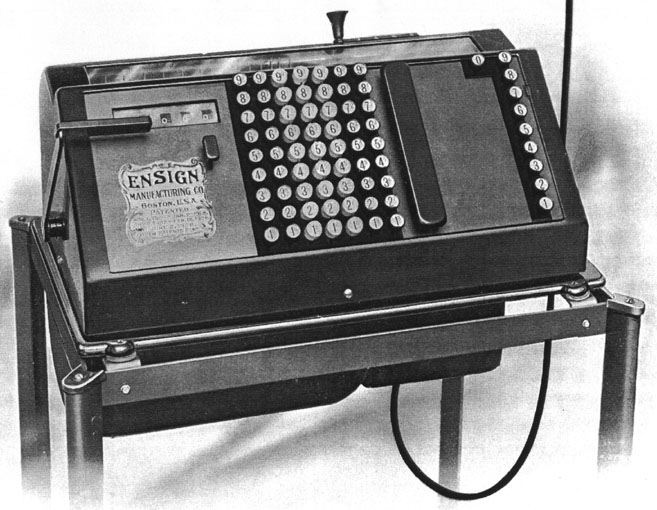 Model E, 1910 ad |
|||||||||||||||||||||||||
|
Monroe Calculating Machine Company Founded 1912 ~ On market 1916 ~ Advertised 1917-30 Monroe Calculating Machine Co., Orange, NJ, New York, NY Full keyboard, crank-operated. Electric introduced 1922. 1916 Price $250. 1924 Prices: Crank-Operated $200-$400; Electric $500-$600. Variable tooth gear. |
  |
|||||||||||||||||||||||||
| Mercedes-Euklid Advertised 1924 Mercedes Büromaschinen-Werke Berlin, Germany |
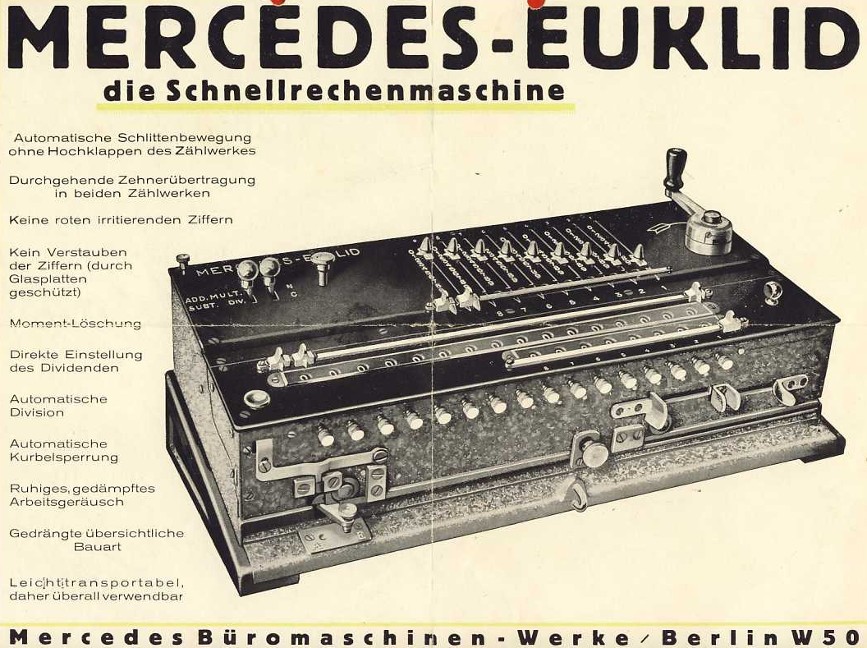 |
