|

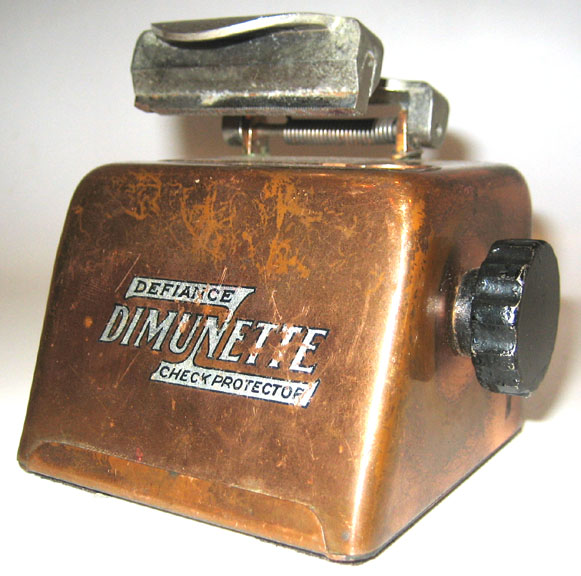
| Early Check Machines |
Protection of Checks Against Fraud
By the early 19th century, various methods were used to attempt
to prevent raising of the
monetary figures and altering the payee on checks and other financial
documents. Some background on various methods used to reduce the ability of
people to raise the amounts on checks and the ways criminals responded is provided immediately
below, based on 1889, 1892, 1907, and 1923 publications.
Immediately below are three pages on check raising published by The Bankers Magazine in 1889:
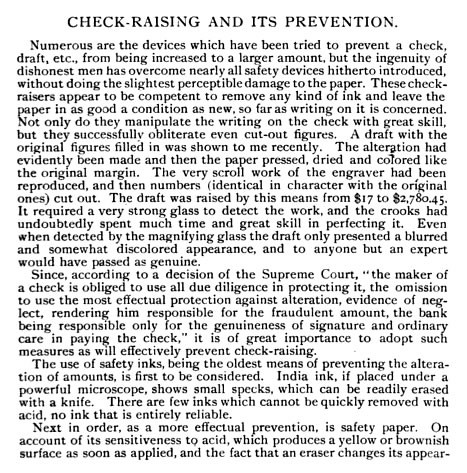
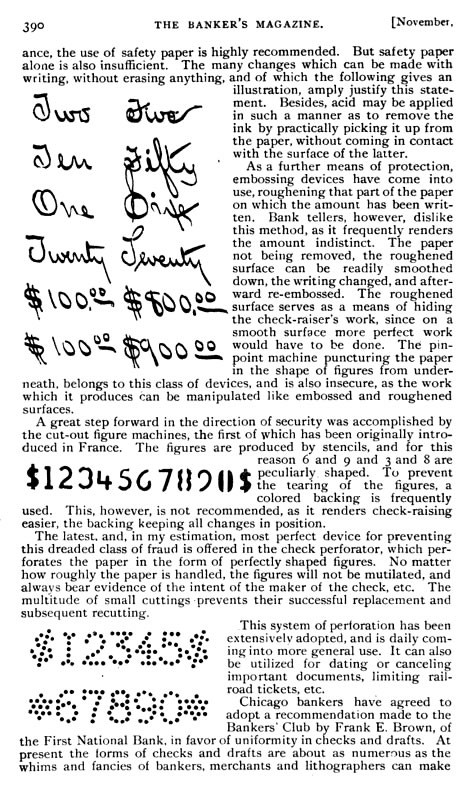
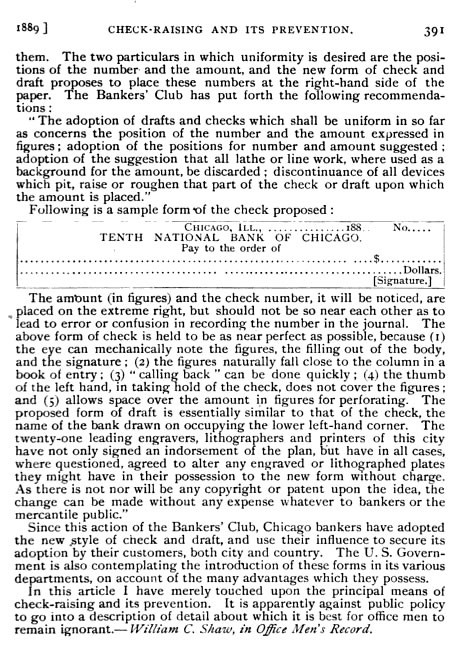
Click on the images to enlarge.
In addressing methods used by criminals known as "check raisers," an 1892 book states: "While it is true that many men fill in their checks so carelessly as to aid the forger, yet care in this regard is not a prevention against check raising. It is an easy matter to change a six, a seven or a nine dollar check to sixty, seventy or ninety, respectively. It is an easy matter to change twenty to seventy." A man reportedly "gave a check for two hundred dollars. In a few weeks it was charged to him, at the bank, as five hundred dollars. The forger had made the f 's cross on the stem of the capital T and removed the last line of the 'o' in the 'two' [so the 'o' could be changed to 'e'] and dotted the first part of the 'w' [so it appeared to be 'iv']. Even the tinted paper used by many...is not a safeguard against check raising, for the forger removes the lines or letters with chloride of lime and, after raising the check, supplies the tint by the use of crayon or water color and a fine pointed pen. The check is then subjected to the calender machine and comes out seemingly perfect. Even the check punches which are coming rapidly into use are not preventives, for there are instances where the figures cut out of the check by these machines have been filled, and by the use of great pressure rendered almost proof against detection. The checks are then altered and a similar check-punch used to perforate the raised amount." (John B. Duryea, A Practical Treatise on the Business of Banking and Commercial Credits, 1892, pp. 176-77)
According to a book published in 1907, drafts "are skillfully altered or
raised by the addition of the word hundred or thousand and of the necessary
ciphers. Where the writing or figures of a draft are to be altered, the
original is obliterated by the use of chemicals, and where sensitive paper is
used the proper color is returned. Even when fine lines are made by the
lithographer upon the draft as a protection against alteration and they become
partially destroyed in the alteration, they are replaced by the expert penman in
so skillful a manner as to almost defy detection. Even the punched-out
holes, giving the amount, are most skillfully filled up by pieces of the same
size, and by the use of paper pulp, the whole being afterwards ironed so as to
completely obliterate the former punchings, and new punchings are made to
correspond with the raised figures." (Albert B. Barrett, Modern Banking
Methods, 5th ed., Bankers Publishing Co, New York, NY, 1907, p. 298)
Three pages from a 1923 publication are provided below:
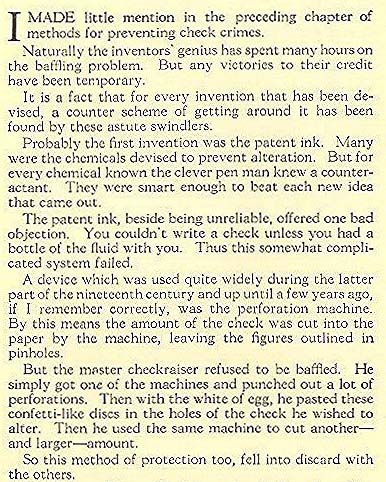
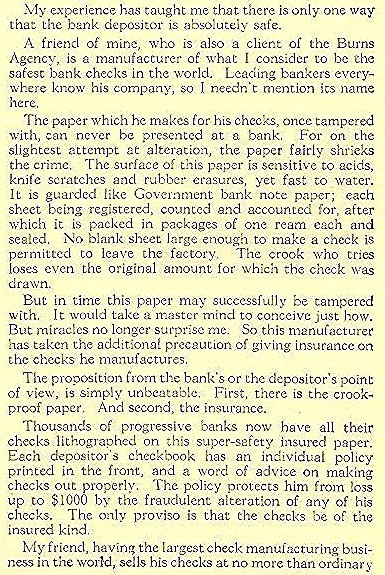
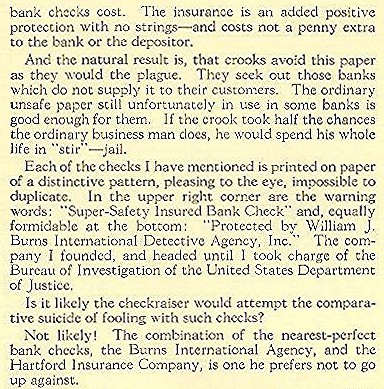
William J. Burns, Stories of Check Raisers and How to
Protect Yourself, 1923, pp. 13, 19-20.
Click on the images to enlarge.
Bank Checks Designed to Prevent Alteration
Both before and after the introduction of mechanical check protectors, some checks were protected in one of a great many other ways. One method was to print upper limit dollar amounts along the edge of the check, with lower limits closer to the body of the check and larger limits farther away, and then to cut off all but the lowest of the printed amounts that exceeded the value of the check. Two examples are provided below.

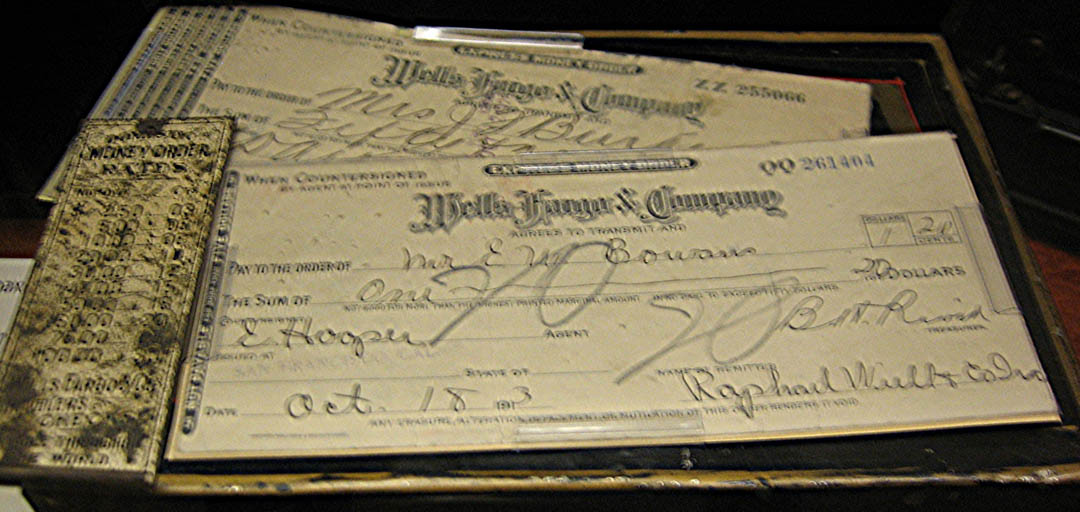
Check used in 1837 (left).
Wells Fargo & Co. money order (right, see left end of the top money order).
(Wells Fargo Museum, San Francisco, CA)
A second method was for the printer of the checks to print a grid of numbers on the check, and then for the person writing the check to mark or punch the relevant numbers. An example from a patent is provided below:
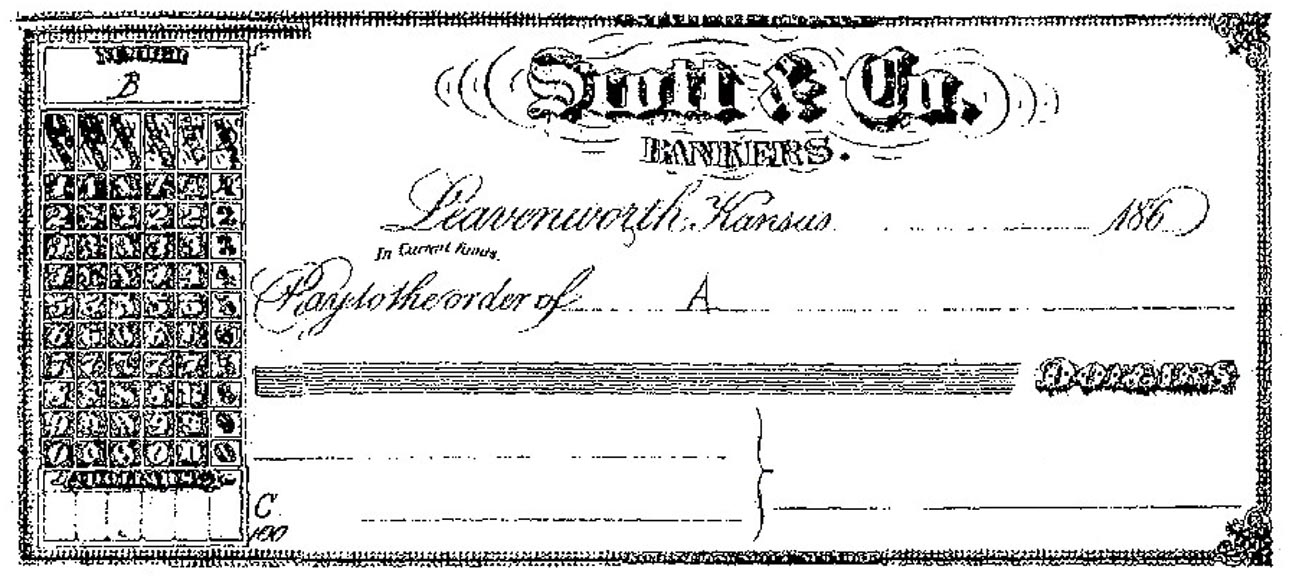
Image from U.S. Patent No. 68,448, awarded
in 1867
A third form of protection was use of paper that facilitated detection of alterations. There were many approaches, e.g., paper was impregnated with chemicals, made of fiber layers with different colors, or printed with patterns. Two early examples are provided U.S. Patent No. 4,143 awarded in 1845 and U.S. Patent No. 5,171 awarded in 1847. Three examples from the second half of the 19th century are shown below:
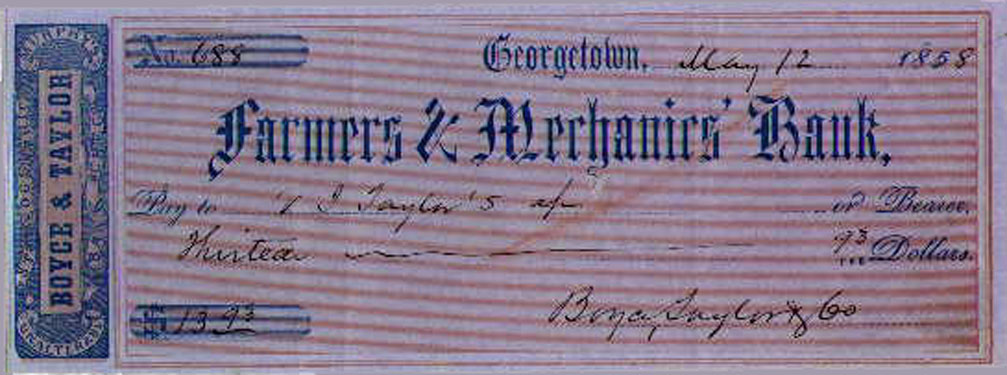
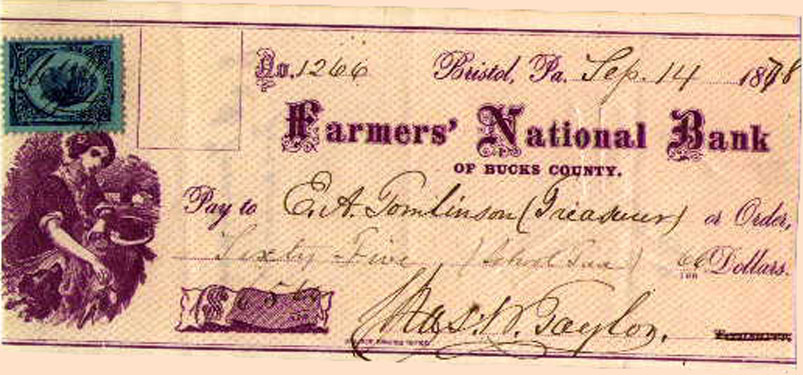
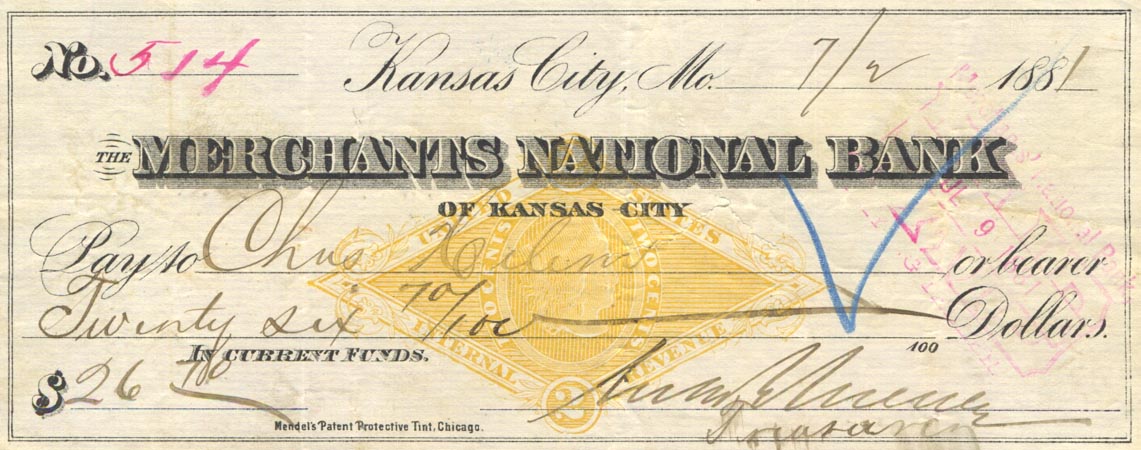
Murphy's Unalterable Stereographic Bank Check, 1858 (left)
Check printed in 1860s and used in 1878 (middle)
Check with Mendel's Patented Protective Tint, 1881 (right).
Mendel was awarded U.S. Patent No. 216,625 in 1879 for Improvements in Ink for
Printing Protective Tints on Commercial and other Blanks.
Antique Mechanical Check Protectors
In 1869, Max Emanuel Berolzheimer of New York, NY, was awarded US Patent No. 97,344 for a check protector that was designed to punch holes in checks that had been printed to be used with this particular machine. This is the earliest evidence of a mechanical check protector that we have found. We do not know whether it was actually marketed. The illustration below left shows the machine. The illustration below right shows the pattern that was printed on the checks as well as another image of the machine and an image of the female die.
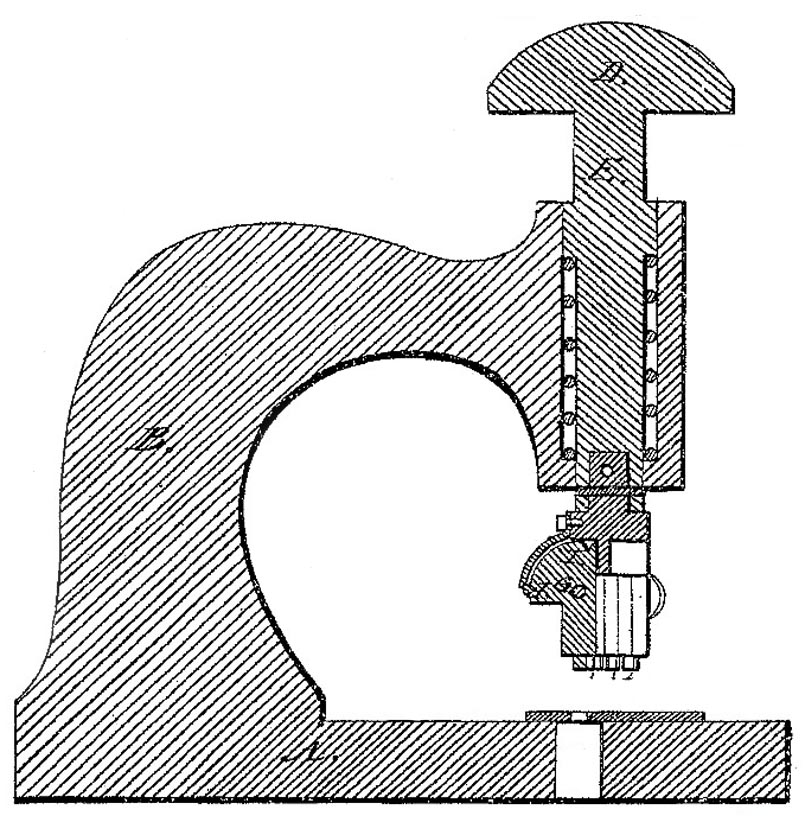
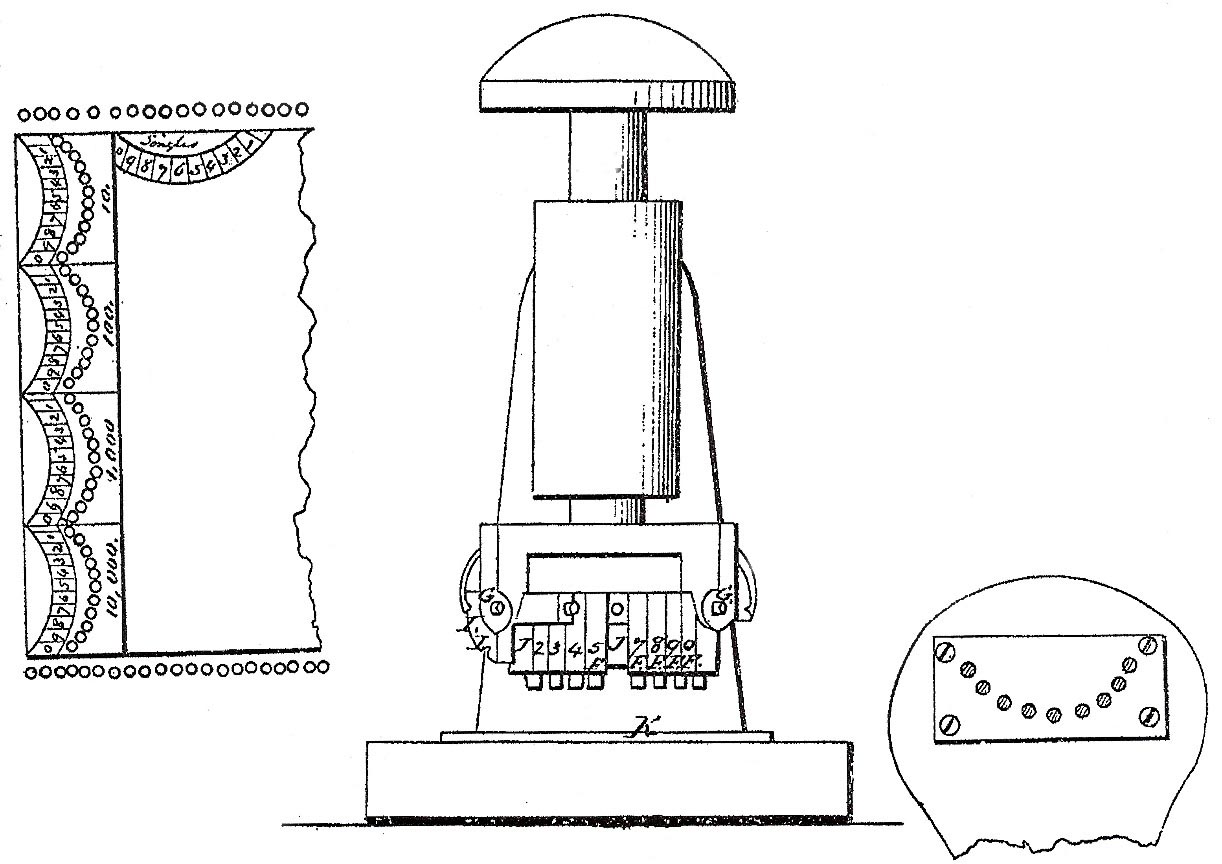
Berolzheimer check protector, patented 1869
[Check on this: A perforating machine for checks, which may have been a check protector or a check canceler, was exhibited by John R. Hoole of New York, NY, at the 1876 Centennial Exhibition. ]
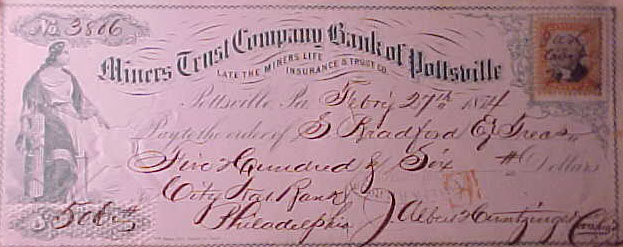
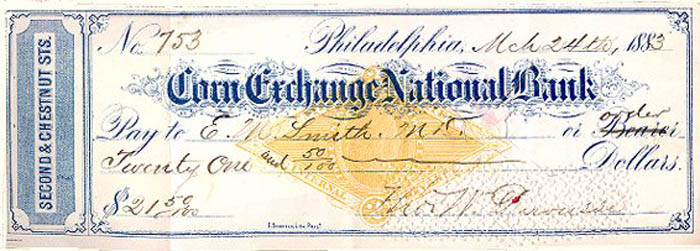
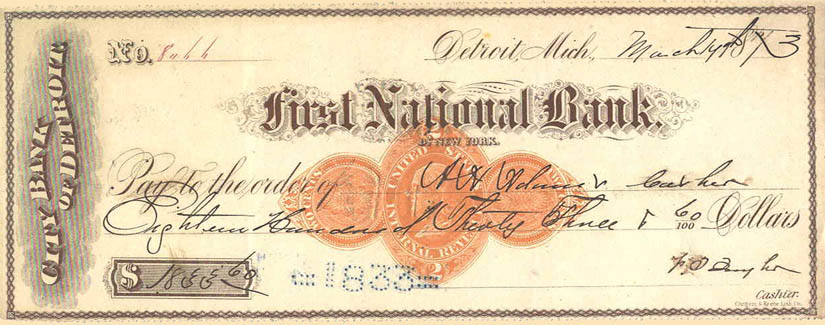
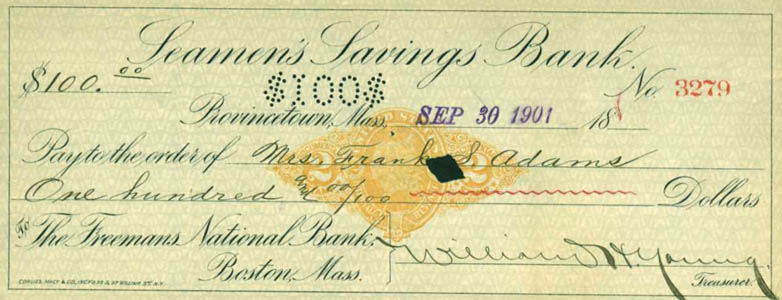
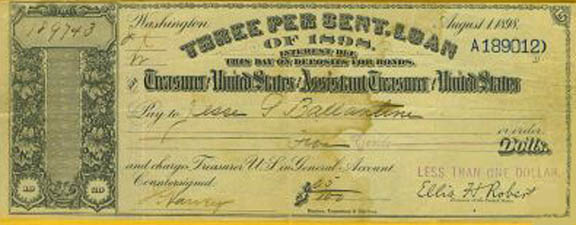
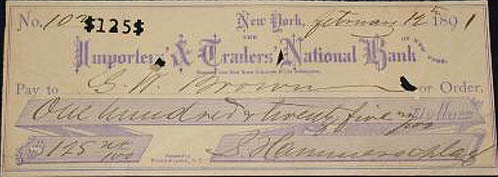
During the last three decades of the 19th century, the principal mechanical check protectors were check punches and check perforators, which cut holes in checks. However, our review of checks for sale on eBay indicates that a comparatively small share of non-government checks during these decades used any mechanical form of protection against alteration of dollar amounts. According to advertisements for the Automatic Check Punch, the U.S. Treasury Department issued hundreds of thousands of checks annually using that particular model of check punch.
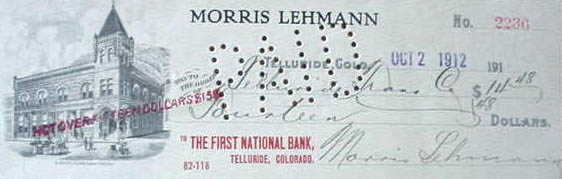
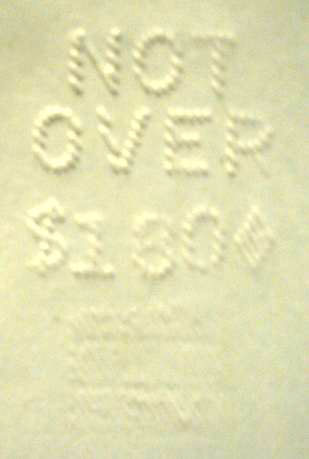
During the early 20th century, other types of check protectors were marketed, in addition to check punches and perforators. According to Leffingwell, new "check protectors introduced the fundamental principle of forcing into the paper the words representing the amount, making them part of the fiber. The first machine operating on this principle was fitted together in 1899. This early model [made by G.W. Todd] embossed the approximate amount of a draft into the paper, using black ink, in the form of a 'Not Over' or limiting line. The succeeding years, up until 1913, were experimental variations on the 'shredding principles.' The result was the perfecting of a check-writing machine shredding the amount of checks."
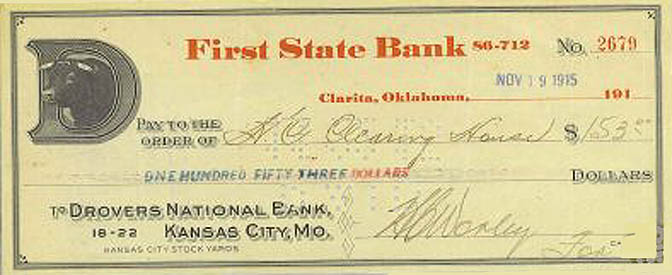
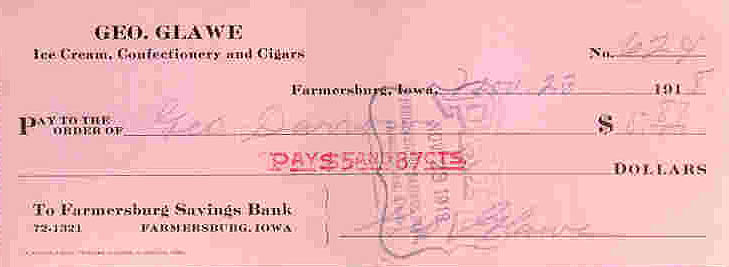
"In 1914 a figure-writing check writer was placed on the market [by Hedman]. This machine printed the amount line of a check in figures, stamping the imprint through the paper of the check. In 1917 a new model appeared on the market [made by Hedman, with another made by Safe-Guard] which had diagonal writing and perforation over the payee's name. In 1919 a check protector [made by Checkometer] which printed the amount in numerals and at the same time perforated an uninked design over the payee's name appeared on the market." (W. H. Leffingwell, The Office Appliance Manual, 1926, pp. 185-89.)
Following the present page, the Early Office Museum's first exhibit covers check punches and perforators from 1869 through 1899. The second exhibit covers check protectors from 1900 to the 1920s. The third exhibit covers simpler check protectors, including handheld devices and ones that embossed fine quilted patterns over the writing on checks. The fourth exhibit covers canceling machines, the fifth covers revenue stamp mutilators, and the last covers check signing machines.
Ways in which Check Protectors Attempted to Prevent Alteration of the Amounts on Checks
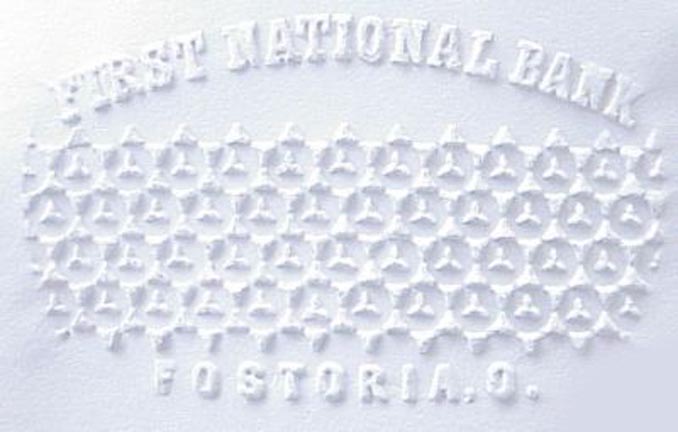

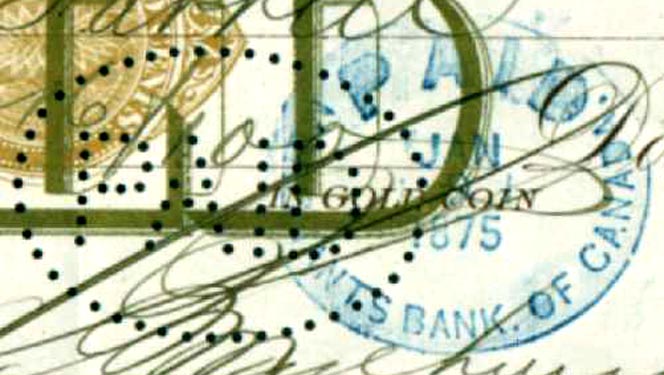



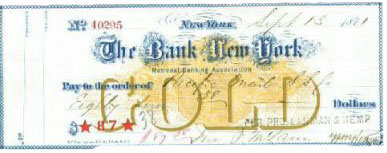
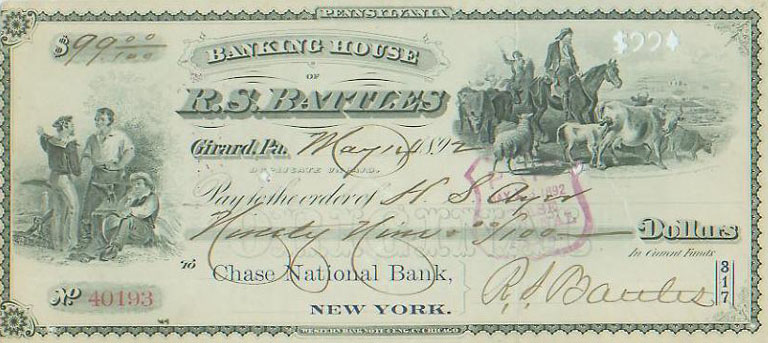

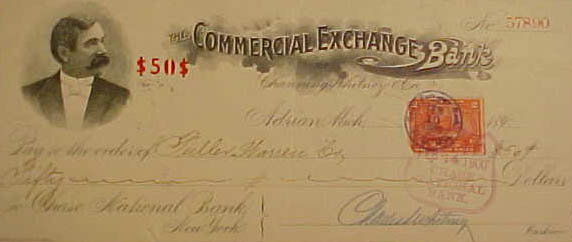







For additional photographs of check protectors, see Michael A. Brown, Antique Check Writers: A Collector's Guide from A to Z, 1998, and Thomas A. Russo, Office Collectibles: 100 Years of Business Technology, Schiffler, 2000.
Buy purchase buying purchasing sell selling antique vintage early victorian old checkwriter check protector punch perforator writer imprinter embosser for sale