|


| Early Office History |
The Evolution of
Offices
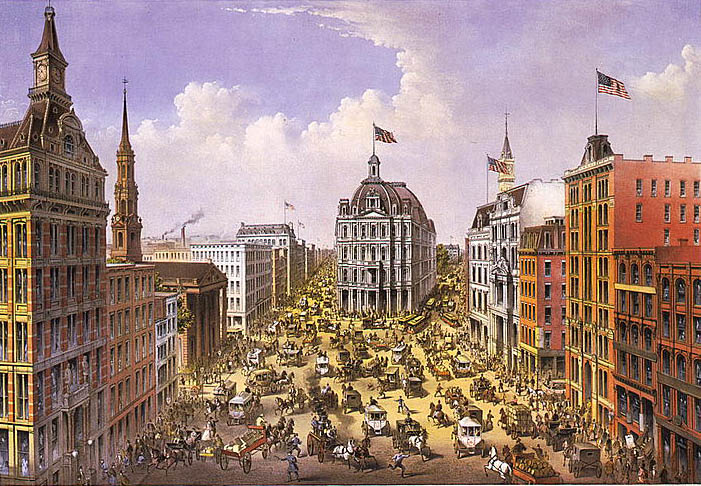

Left: Broadway, New York, from the Western Union
Telegraph Building Looking North, Currier & Ives, 1875, Library of Congress, P&P Division, LC-USZC2-1712
Right: Broadway from the Post Office Building Looking South, c. 1880.
These two images show the same section of Broadway from opposite
directions.
The tall building at the left of the image at the left can be seen right of
center in the image at the right.
If you had visited offices in a large American city in 1880 and then returned in 1920, you would have observed profound increases in:
- The height, size, and number of office buildings.
- The number of office workers, particularly clerical workers.
- The share of clerical workers who were women.
- The use of specialized office machines for typing, stencil duplicating, check writing, pencil sharpening, paper fastening, adding and calculating, addressing, dictating, tabulating, and bookkeeping.
- The use of other specialized office products, e.g., filing equipment and paper forms.
- The use of new equipment that was not specific to offices, e.g., telephones, electric lights, electric fans, cash registers, time clocks, and pneumatic tube systems.
Point (1) is addressed in the Museum's exhibit on Early Office Buildings. Points (2) and (3) are discussed in the Museum's exhibit on Office Workers. Points (4), (5) and (6) are covered in the Museum's numerous exhibits on the machines and equipment that were used in early offices. The output of the US office equipment industry, measured in constant dollars, nearly tripled during each decade during 1880-1910. (James R Beniger, The Control Revolution, 1986, p. 398, citing Daniel Creamer et al., Capital in Manufacturing and Mining, 1960, A-8, A-10)
The Museum's exhibit on Office
Equipment & Supplies at the Centennial Exposition provides a glimpse of the
limited range of items that were available for offices in 1876. The
Museum's exhibit on Early Office
Buildings provides an overview of the exterior of early offices. The
Museum's exhibit on Early Photographs of Office
Interiors provides a chronological tour of office interiors.

