Back ] Home ] Up ] Next ]  


Revenue Stamp Mutilators


Revenue Stamp Mutilators

revenue_stamp_mutilator.jpg (20102 bytes)

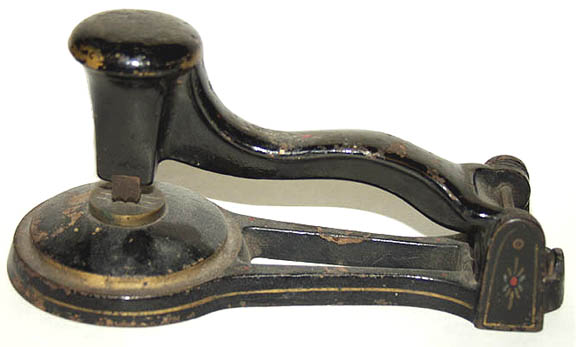
According to a 1915 product announcement, "In accordance with the ruling of the Internal Revenue Department [on the War Tax Revenue Law], all revenue stamps to the value of ten cents or more must be mutilated with three parallel incisions, cut through the stamp after being affixed to the document. This is in addition to stamping the same with the initials of the user and date of use.” This legal requirement created a demand for devices, known as revenue stamp mutilators, that cut three straight or undulatory incisions through both the revenue stamp and the document to which the stamp was affixed. 

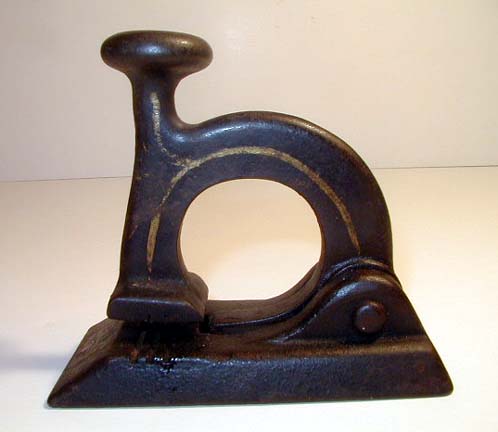
The photograph above shows an unmarked cast iron revenue stamp mutilator. Attached to the underside of the end of the pivoting arm are three parallel vertical steel knife blades about 1” in length (measured side to side) and 1/8” apart. When the knob on top of the device is pushed down, the blades fit into three slots in the base or anvil. If one inserts papers under the head and pushes down, the device makes three parallel incisions. A photograph of an office at the Tradesmen's Trust Company in Philadelphia taken in July 1907 shows this identical revenue stamp mutilator on a desk (The Hoskins Company Catalog, Philadelphia, c. 1910).

Click on Image to Enlarge  Description
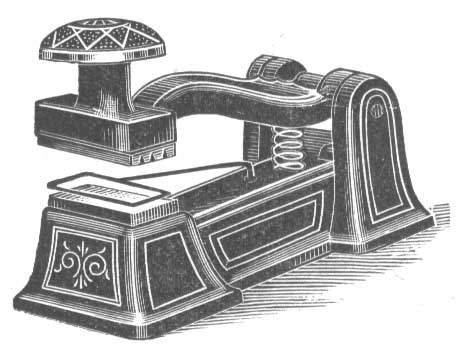
1900_Revenue_Stamp_Mutilator_National_Seal__Stamp_Works_ad.jpg (28353 bytes)

Revenue Stamp Mutilator (a.k.a. Handy Revenue Stamp Mutilator)
Advertised 1900, 1915
National Seal & Stamp Works, Baltimore, MD (1900)
A. D. Joslin Mfg. Co, Chicago, IL (1915)

1900_Diamond_Revenue_Canceller_ad.jpg (19662 bytes) Diamond Revenue Canceller
Advertised 1900
A. W. Martin & Co.
Chicago, IL
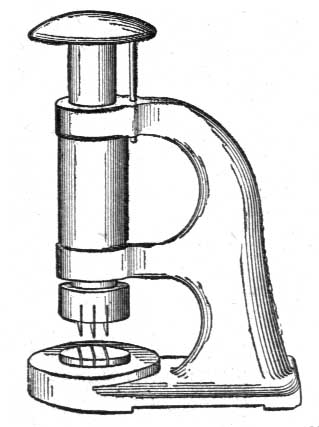
Revenue_Stamp_Multilator_xx.jpg (28686 bytes) Revenue Stamp Mutilator
Image coming Revenue Stamp Cutter
Advertised 1917
C. H. Morse & Son
Rochester, NY


All material on the Early Office Museum web site is copyrighted.  All rights are reserved.


First, you must not plagiarize our material.  Plagiarism is the act of passing off as your own the words, photographs, or other work of someone else.  Second, you must not violate our copyright or any one else's copyright, which means you may not use any images or text from the Early Office Museum web site in publications, in direct mailing material, on web sites, in auction listings, or anywhere else without written permission from the Curator (see link on home page).  In some cases, images belong to someone else, and we cannot give permission.  If you make legitimate non-infringing use of information from this web site, you must cite the Early Office Museum and provide our web address (www.officemuseum.com or www.earlyofficemuseum.com) or a link.  "Legitimate non-infringing use" is non-commercial use of no more than two images and 300 words of text, enclosed in quotation marks.  People who use material from this web site without giving proper credit are below green slime on the evolutionary scale.